
The Rhythms That Help Me Manage My Time (and My Energy)
When people ask me how I manage my time, I always pause before answering — because what I’ve learned is that time management isn’t really about doing more. It’s about choosing well.
Over the years, I’ve built a handful of simple rhythms that help me stay grounded, focused, and present — in my work, with my family, and with myself. None of these are about perfection or productivity for productivity’s sake. They’re about clarity, sustainability, and creating a pace of life that actually feels good to live inside of.
Here are the practices that help me do that.
1. I Set Goals — Personally and Professionally
Everything starts with clarity.
I take time to set goals in both my personal and professional life because it gives me a clear lens for decision-making. When I know what I’m working toward, I can more easily ask myself, Is this truly my responsibility? or Is this nourishing the person I want my future self to be?
On a daily basis, I come back to that question. By defining not just what I want to accomplish, but how I want to show up for myself and others, I’m able to align my focus — and just as importantly, let go of things that might be good, but aren’t right for me in this season.
This process always begins with reflection:
What am I truly responsible for right now?
How do I want to spend my free time?
What do I love and want to protect?
What am I ready to adjust or release?
From there, goals naturally take shape. Some are very practical — like wanting to start a personal blog this year or ensuring our team has complete clarity on where we’re going as a company and how each department contributes. Others are more life-giving — like blocking weekly quality time with my girls or protecting Sunday as a true day of rest.
I share more about how we approach goal-setting as a company in this blog post on how Graceful Spaces sets goals.
You can also see how this shows up in my mornings in my morning routine blog.
Not All Goals Are Measured by Outputs
While not every goal can (or should) be measured by a simple checkbox, I do love using the OKR framework (Objectives and Key Results).
The objective is the big, sometimes lofty outcome — the thing you want to feel or see changed. From there, I determine a few key results that act as mile markers, giving me clues that I’m moving in the right direction.
For example, if my objective is to write a personal blog this year, my key results might be:
Clarifying and capturing the purpose of the blog
Creating a realistic framework for how I’ll write
Publishing a certain number of posts each month
For me, this isn’t about achievement — it’s about awareness. The key results tell me whether my habits and routines are actually supporting what I want to do.
If the clues aren’t working, I move into one of three decisions: adopt, adjust, or abandon.
Adopt a new habit or routine
Adjust the goal or the approach
Or lovingly let it go if it’s not a true fit
That permission alone is incredibly freeing.
2. I Time Block My Week
Time blocking has been one of the most impactful changes I’ve made.
Each day of the week has intentional blocks for how I plan to spend my time — including working out, morning tea with the girls, weekly connection time with Graeme, and free time. For work, I block time across the four major buckets of responsibility I carry.
What I love most about this is that it forces honesty. I can clearly see when I’m at capacity in a certain area — and just as importantly, I know when I actually have space.
For example, Tuesday afternoons are blocked for personal appointments. That means I don’t scatter errands and appointments across the week. I always know where they go, which makes scheduling easier and keeps my energy more focused.
The result? When I’m leading, I’m all in. When I’m with my family, I’m present. When I’m focusing on my health, I have the space not only for appointments, but for the follow-up and processing that often gets overlooked.
This system has given me so much freedom. Yes, sometimes it means scheduling a meeting two or three weeks out — but that’s actually the gift. I can clearly see when my time is full instead of holding an unrealistic view of what I think I can fit in and slowly losing the things that fill me up.
3. I Map Out the Entire Year
This is a practice I adopted from Graeme, who has kept a large annual master calendar in his office for years. When I finally tried it myself, it was truly eye-opening.
I start by blocking out vacations and holidays, then add the kids’ events and major work commitments. Just doing that fills a surprising amount of the year.
From there, I layer in larger work projects that align with my goals and identify when I realistically have the capacity to focus on them.
What I discovered was incredibly grounding: between summer vacations, moves, and holidays, I lose about two weeks each quarter — meaning I actually have closer to 10 true working weeks per quarter, not 12.
Seeing that reality on paper brought so much peace. I stopped counting on time I didn’t have, prioritized the projects that truly move the needle, and scheduled them in seasons where I know I can show up fully.
4. I Loosely Meal Prep
I’m a big believer in loose structure.
Each week, I plan for about five dinners and make sure we have the ingredients on hand. One or two meals are flexible enough to roll into the next week if life gets busy. I don’t assign meals to specific nights — that flexibility matters to me.
This simple practice removes the mental load of deciding what to make each night and supports my goal of eating nourishing meals at home.
A little tradition in our house: Thursday night is always nacho night. Over time, we’ve found ways to make it more nourishing — swapping chips for cauliflower, using Greek yogurt instead of sour cream, and adding life-giving extras like nutritional yeast and fresh cilantro. It’s a rhythm that feels both fun and supportive.
5. I Only Grocery Shop Once a Week
I genuinely love grocery shopping — but it can be a huge time drain.
A major support for me has been doing one online grocery order each week and using drive-up pickup. It saves time, reduces mental energy, and helps us actually use what’s already in the fridge.
Maybe one day I’ll love stopping by a market daily to make dinner, but in this season of life, I find so much peace in the simplicity of a once-a-week shop.
Choosing a Pace That Allows Me to Stay
All of these rhythms do one important thing: they bring clarity.
They help me see what I truly want to do and when I can realistically do it. They force me to weed out the things that quietly steal time and energy. They protect space for rest and for the things that build me up.
Most importantly, they keep me from constantly chasing the next thing.
I have comfort in knowing that I chose what fits, I chose a healthy pace, and I created a life where progress doesn’t require burnout. These practices allow me to enjoy the achievement of goals and the settling — the celebration of milestones, the pauses, and the rest in between.
And for me, that’s what graceful living really looks like.
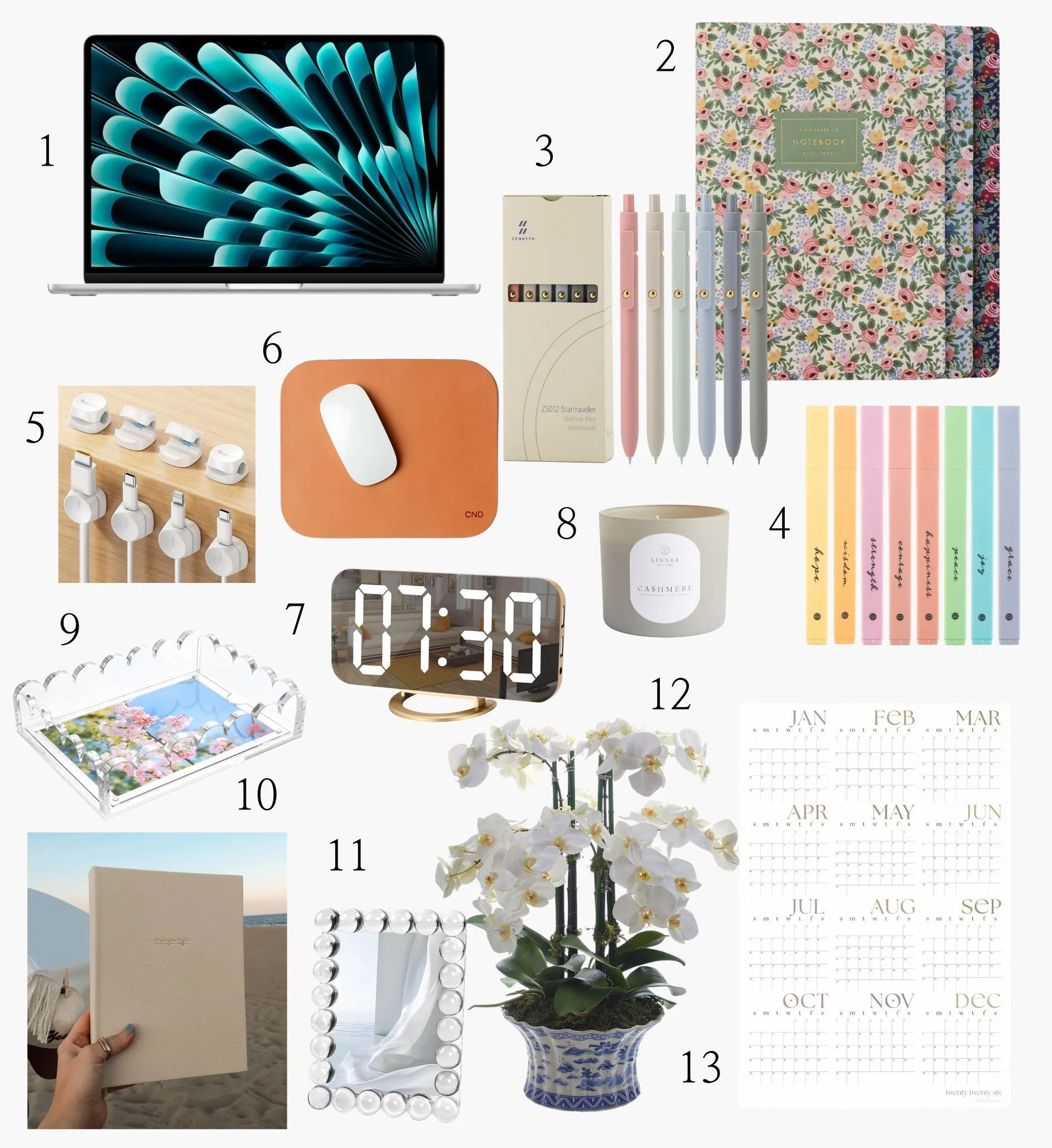
1. Apple Mac Book 2. Rifle Paper Co. Notebooks 3. Christina’s Favorite Gel Pens 4. Christina’s Favorite Highlighters 5. Cord Organizer 6. Leather Mouse Pad 7. Elevated Clock 8. Christina’s Favorite Candle 9. Acrylic Tray with Magnetic Mat 10. Living in Light Journal 11. Acrylic Bubble Picture Frame 12. Orchid 13. Yearly Planner
xo,
Christina
P.S. I’ll include a few affiliate links for the items I use and love — but my hope is that the real inspiration comes from the activity itself: showing up with intention, embracing beauty in the everyday, and weaving joy into even the simplest routines.